Candy Thermometers and the Soft-Ball Stage, Explained
How to choose, calibrate and use a candy thermometer, what the soft-ball stage (234–237°F) means for fudge, and how to use the cold-water test.
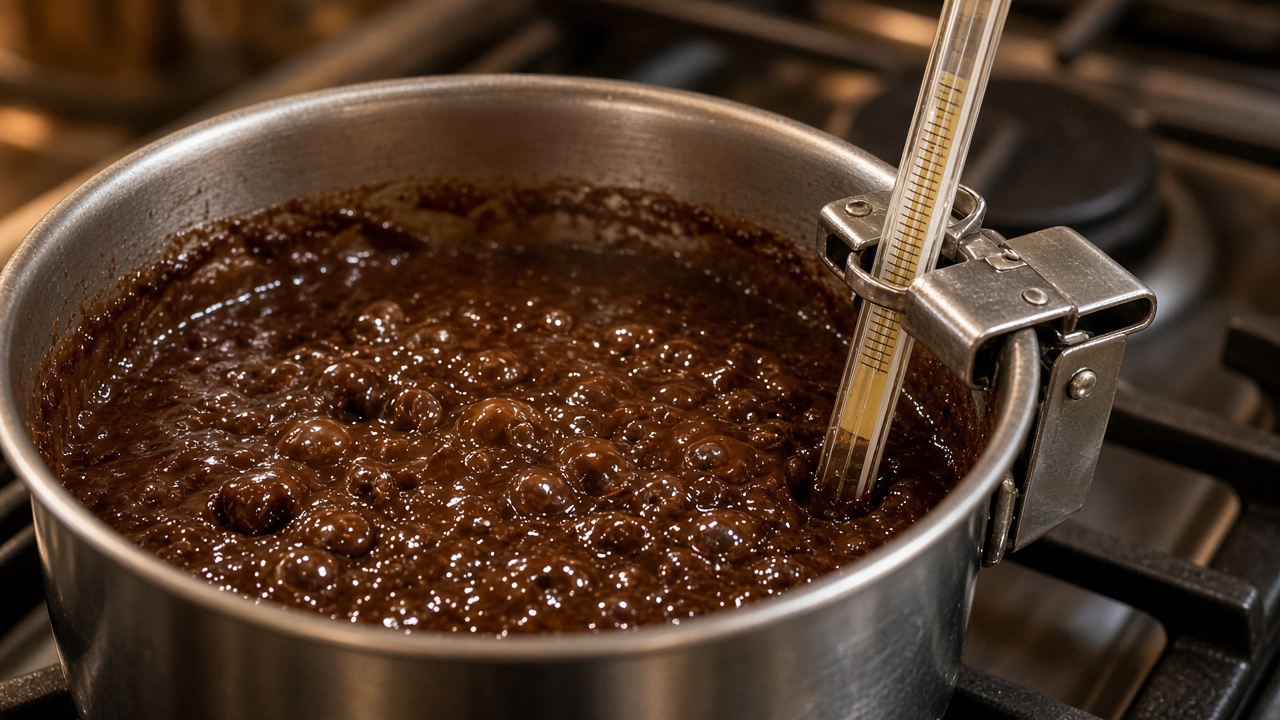
Ask any Pageant finalist what their most important tool is and very few will say "my grandmother's spoon." Most will hold up a thermometer. Fudge is a candy of precision: a few degrees separate a soft, scoopable puddle from a creamy square and a crumbly brick. Here's how to make temperature your friend.
What is the soft-ball stage?
As a sugar syrup boils, water evaporates and the concentration of sugar rises. The boiling temperature rises with it, so temperature is a reliable stand-in for how much water is left. Candy makers group these temperatures into stages, named for how a drop of syrup behaves in cold water:
| Stage | Temperature | Used for |
|---|---|---|
| Thread | 223–235°F (106–112°C) | Syrups, glazes |
| Soft ball | 234–240°F (112–116°C) | Fudge, pralines, fondant |
| Firm ball | 244–248°F (118–120°C) | Caramels |
| Hard ball | 250–265°F (121–129°C) | Nougat, marshmallows |
| Soft crack | 270–290°F (132–143°C) | Taffy, butterscotch |
| Hard crack | 300–310°F (149–154°C) | Lollipops, brittle |
For classic fudge, most recipes target 234–237°F (112–114°C), the lower part of the soft-ball range. Toward 234°F you get a softer, creamier fudge; toward 237°F it's firmer and sliceable. Go much higher and the fudge turns hard and crumbly.
Choosing a thermometer
- Clip-on glass or dial candy thermometer: inexpensive and stays in the pot hands-free. Look for clear markings in 2°F steps, and a foot or guard that keeps the bulb off the bottom of the pan.
- Digital probe thermometer with a pot clip: fast and easy to read, and many have alarms you can set to 234°F. This is the favorite of our imaginary Grand Tent judges.
- Instant-read thermometer: accurate and handy for spot checks, but you have to hold it, and steam over a boiling syrup is hot. Use it as a backup.
Calibrate before every big batch
Thermometers drift. A thermometer that reads 3°F off can ruin a batch without you ever knowing why. Here's how to check yours:
- Bring a pot of plain water to a full, rolling boil.
- Put the thermometer in so the tip sits in the water and isn't touching the bottom.
- Wait a minute and read it. At sea level water boils at 212°F (100°C).
- Note the difference. If it reads 210°F, it reads 2°F low, so your fudge target becomes 232–235°F.
Altitude matters too. Water boils about 1°F lower for every 500 feet of elevation. In Denver, around 5,280 feet, it boils near 202–203°F. The calibration test accounts for altitude and thermometer error at the same time, so just subtract the difference between your boiling reading and 212°F from the recipe's target. Barometric pressure shifts it a little from day to day, which is why serious candy makers re-check often.
Reading it correctly
- Depth: the sensing tip must be in the syrup, not in the foam and not touching the pan bottom. Tilt the pan briefly if the batch is shallow.
- Eye level: read glass thermometers at eye level to avoid parallax error.
- Watch the end: the temperature climbs slowly through the 220s, then speeds up. Above about 228°F, stay close.
- Carryover: pull the pan off the heat right when it hits your target. A heavy pan keeps cooking for a few seconds.
The cold-water test (no thermometer? no problem)
Before thermometers were common, cooks used a bowl of very cold water, and it still makes a great double-check.
- Fill a small bowl with ice water.
- Drop about 1/2 teaspoon of syrup into it.
- After a few seconds, gather it with your fingers.
- Soft ball: it forms a soft, squishy ball that flattens within a few seconds when you take it out of the water. If it dissolves into threads, keep cooking. If it holds a firm shape, you've gone past soft ball.
Use a fresh spoon each time, and take the pan off the heat while you test if you're close, so it doesn't overshoot.
Thermometer care
Never plunge a hot glass thermometer into cold water, because it can crack. Let it cool, then soak it in warm water to dissolve hardened sugar. Store glass thermometers in their sleeve. If a glass thermometer's liquid column separates, replace it.
A Pageant tale
Legend in Springfield (a place that exists only in our imaginations) says the 2022 champion, Ozzie Fondant, lost his first two semifinals by a combined four degrees. He came back with two calibrated thermometers clipped to opposite sides of his pot and a kitchen timer for good luck. His Peanut Butter Thunderclap set perfectly. Moral: trust your thermometer, but verify it first.
Ready to put it to work? Head to our classic chocolate fudge recipe.